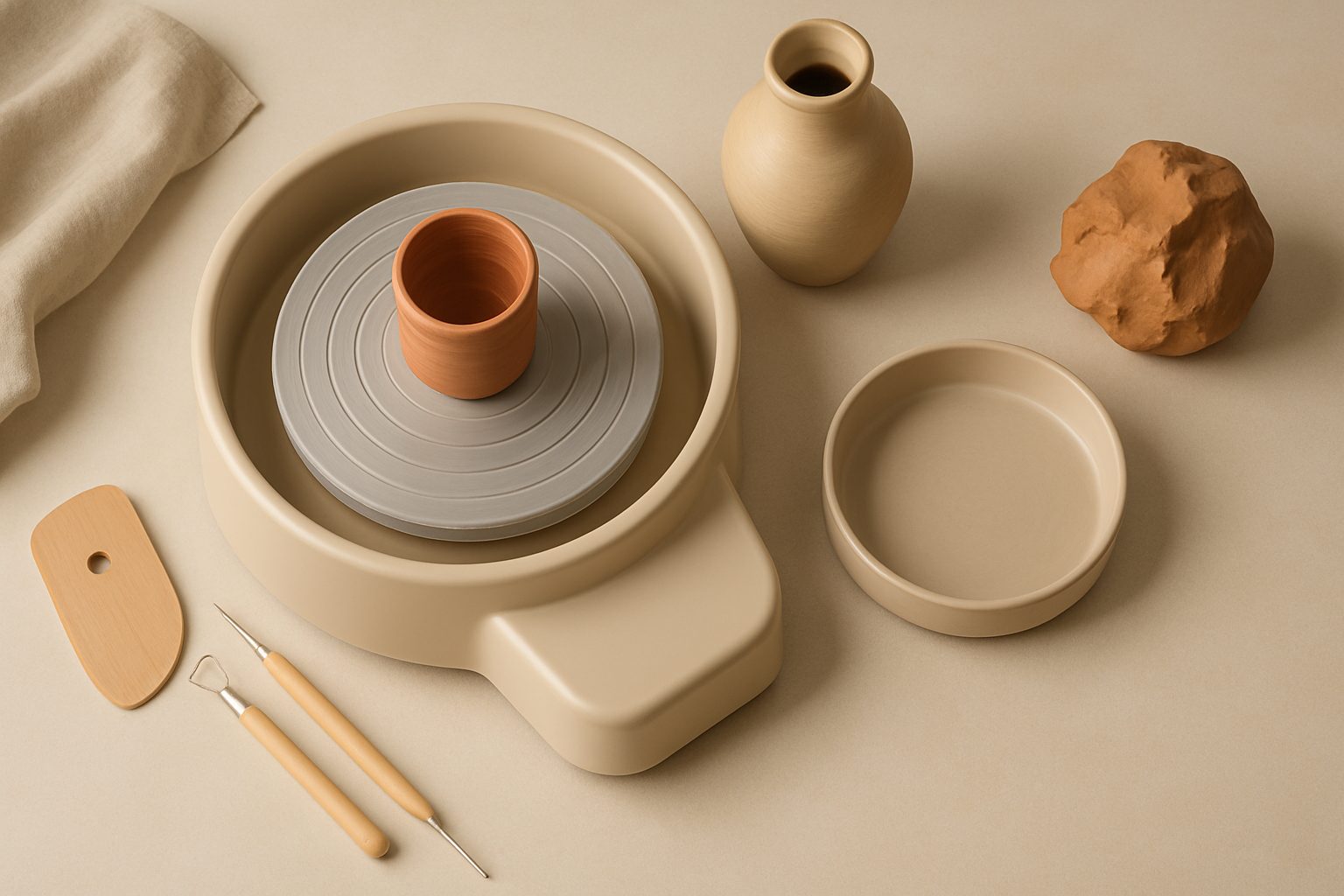
Best Tabletop Pottery Wheels for Small Spaces UK (2025 Guide)
If you've got a pottery habit but live in a flat, small house, or share studio space, a full-size pottery wheel isn't realistic. A tabletop model solves that. The trick is finding one that actually stays put when you're centering clay—not one that wobbles off the edge of your desk halfway through a pot.
This guide focuses on three compact wheels that work well in UK homes: the Speedball Artista, Shimpo Aspire, and Vevor tabletop. All three have decent weight capacities and proven stability on standard furniture, but they suit different budgets and space constraints.
What Makes a Tabletop Wheel Practical for Flats
Tabletop wheels work because they're light enough to move and store, yet heavy and wide enough to avoid sliding when you apply lateral pressure to the clay. The trade-off is smaller clay batches—most won't handle more than 2–3 kg comfortably—and less headroom for tall forms.
Three things matter most:
- Weight and footprint: A wheel between 10–15 kg with a wide, low centre of gravity stays put on a desk or wheeled cart without needing bolts. Anything lighter tends to creep.
- Table load capacity: Your desk or table must safely hold the wheel plus you leaning in. Most domestic tables manage 15–20 kg easily, but check yours if it's vintage or flimsy.
- Motor noise: Smaller wheels often have cheaper motors. A loud one in a flat neighbours won't forget. Brushless motors are quieter than brushed.
Speedball Artista: Budget-Friendly and Honest
The Speedball Artista is the cheapest option, usually around £200–250 new in the UK. It weighs about 6 kg, which is very light. This is both its strength and weakness.
Pros: It's genuinely portable—you can toss it in a bag and move house easily. The motor is decent for its size, reaching 240 RPM. Setup takes five minutes: just plug it in. Great if you're experimenting before committing to pottery seriously.
Cons: At 6 kg, it needs a very stable table and you'll feel it shift slightly under clay pressure. The foot ring is small, and the clay capacity maxes out around 1.5 kg realistically. If you want to throw anything wider than a small bowl, you'll struggle. The wheel head is quite shallow too, so centering taller forms is awkward.
The Artista works best if you're throwing small pieces—espresso cups, tiny vessels, test forms—and you have a rock-solid table that won't budge.
Shimpo Aspire: The Reliable Middle Ground
Shimpo is a Japanese maker with a solid reputation. The Aspire sits in the mid-range, around £400–450, and weighs roughly 12 kg.
Pros: Rock-solid stability. This wheel barely moves. The motor is brushless and very quiet—important in flats. Reach up to 300 RPM and maintain speed even with 2–3 kg of clay. The wheel head is larger and deeper than the Speedball, giving you much more room to work. It's genuinely professional-grade for the price. Shimpo wheels hold their resale value well too.
Cons: At 12 kg, it's less portable. Moving it means dedicating it to one spot, or using a rolling table. It's overkill if you're just testing whether pottery is for you. The slower max RPM than some competitors is fine for tabletop work, but if you like high-speed throwing, you'll notice it.
The Aspire is the goldilocks option: heavy enough to be stable, light enough to move with help, quiet enough for shared walls, and capable enough for serious work.
Vevor Tabletop: Larger Clay Capacity
Vevor is a Chinese manufacturer selling directly in the UK via Amazon and their own site. Their tabletop wheel runs £250–350 depending on model, weighs around 14 kg, and can handle up to 5 kg of clay—the largest capacity of the three.
Pros: You can throw bigger forms: dinner plates, larger bowls, taller vases. The wheel head is noticeably spacious. Motor reaches 300 RPM. At the lower end of the price range, you get a lot of capability. Fine for intermediate throwers.
Cons: Quality control is inconsistent. Some buyers report wobbly wheel heads out of the box; others have no issues. It's noisier than the Shimpo—the brushed motor hums. Vevor's UK customer support is slower than Shimpo's. Build quality feels noticeably cheaper: the foot pedal can feel flimsy after a few months.
It's a good choice if you want capacity and don't mind accepting that it might need fettling, or if you're buying on tight budget.
Stability in Practice
Whichever wheel you choose, put it on a table where you can brace your elbows—pottery throwing needs stability from your body and the equipment. A small rolling cart works better than a high desk because you can tuck your hips against it. Avoid glass tables (slippery and can crack) and very old tables (sag unexpectedly).
For any tabletop wheel, a rubber mat underneath stops creeping. Fold a yoga mat or buy stick-on anti-slip pads from any DIY shop.
Which One to Buy
Choose the Artista if you're new to pottery or making small decorative pieces, and you're okay with limited clay capacity.
Choose the Aspire if you throw regularly, value quietness, want a genuinely stable platform, and can spare £400. This is the best choice for most UK flat-dwellers serious about the craft.
Choose the Vevor if you want to throw larger pieces and your budget won't stretch to Shimpo, but accept that build quality is middle-of-the-road.
All three will sit safely on a standard desk if the table itself is sturdy. Start with one, and if you're still throwing pottery in two years, you'll probably upgrade to a full-size wheel—but you'll have learned what you actually want from pottery first.
More options
- Shimpo Aspire Pottery Wheel (Amazon UK)
- Speedball Artista Pottery Wheel & Starter Kit (Amazon UK)
- Vevor Electric Pottery Wheel (Budget Range) (Amazon UK)
- Pottery Tool & Accessory Sets (Amazon UK)
- Air-Dry & Stoneware Pottery Clay (Beginner Packs) (Amazon UK)